Immersive Web: Why Static Sites are Becoming Relics of the Past
The End of the Document Web
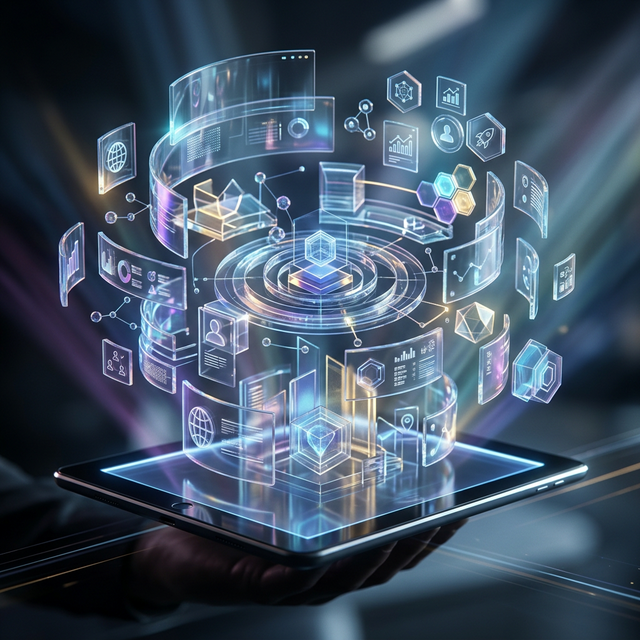
For thirty years, the web has been based on the metaphor of a 'document'—a flat page with text and images that you scroll through. But humans don't live in a 2D world, and in 2026, we are no longer satisfied with 2D websites. We are moving from the 'Document Web' to the 'Immersive Web,' where sites are 3D experiences that you inhabit, not just view.
At AD Fusionz, we utilize technologies like Three.js and WebGL to create 'Spatial User Experiences.' We aren't just showing you a product; we are inviting you to hold it, rotate it, and explore its every detail in a beautiful, reactive 3D environment.
1. The Psychology of Immersion: Higher Trust, Faster Sales
Why does immersion matter? Because 'Seeing is Believing.' A flat photo of a product can be staged or photoshopped. A 3D model that you can interact with in real-time builds a level of 'Perceptual Trust' that a static image never can. It reduces the 'Risk Barrier' for the consumer because they feel they have truly inspected the product before buying.
This is particularly critical for high-end services and luxury goods. When a user spends five minutes interacting with a 3D visualization on your site, they are building a mental 'Ownership' of that product. This psychological investment leads to significantly higher conversion rates and a dramatic reduction in product returns.
2. Spatial UI: Natural Interaction Models
In an immersive web experience, the UI (User Interface) doesn't just sit on top of the content; it is *part* of the content. Buttons follow the curve of 3D objects; navigation moves through space as you explore; and information is revealed through natural interaction. This is 'Spatial UI.'
By mirroring how people interact with objects in the real world, we make the web feel more intuitive. We eliminate the 'What do I click?' friction of traditional sites. In an immersive world, the user simply follows their curiosity. This 'Discovery-Led' UX is the most powerful way to keep users engaged and moving down your sales funnel.
3. Performance Without Compromise
A common fear is that '3D means slow.' In 2026, this is a myth. With advanced compression techniques (like Draco and KTX2) and efficient rendering engines, we can deliver high-fidelity 3D experiences that load faster than a standard image-heavy 'flat' site.
We specialize in 'Progressive Immersion.' The user gets the core information instantly, while the high-end 3D assets load seamlessly in the background. This ensures you never sacrifice SEO or speed for beauty. You can have a site that is both a high-performing business tool and a stunning cinematic experience.
Conclusion: Be the Destination, Not a Stop
The internet is becoming a collection of experiences, not just a list of links. In this new landscape, a static website is nothing more than a digital brochure. By building an immersive web presence, you turn your site into a destination—a place that people *want* to spend time in. Don't just build a page; build a world. The future of the web is three-dimensional, and it's already here.
AD Fusionz Team
Growth Strategists & Creators